
We misunderstand his idea of happiness and his detachment from material possessions. We know little about his vision and his motivations. The most beloved figure is also the least emulated in the history of Christianity
by Luigino Bruni
published in Avvenire on September 6, 2026
Any discussion we have today about Francis of Assisi must begin with the awareness that we understand very little about him, because he lives in a world far away—perhaps too far away. We no longer have any idea what poverty meant to him. This is an unbridgeable distance and ignorance, even though Francis is one of the medieval figures about whom we have the most historical information. We are ignorant of Francis because we have lost touch with nearly every aspect of what made up the life of a man in the early 13th century: his psychology, his religion, his spirit, and his heart elude us. We know some of his words, a few episodes from his life, a handful of texts and songs, but we know almost nothing about what Francis truly thought of his people in Assisi, of his father Bernardone, of his companions, of Clare, of religion, of God—what his heart told him before he fell asleep. For the innermost mystery of every person eludes us, including the people we live with at home; but if this person lived eight centuries ago—and, moreover, had received a charism of enormous significance—then the mystery surrounding the person of Francis is compounded by the mystery that shrouds the secret of every charism.
And so the hedge of Assisi grows very thick; little sunlight manages to penetrate it—just a few rays that may nevertheless suffice for us if we are willing to remain uncomfortable in the certainty that we cannot touch his heart, and to be content with this lack—for only with a taste of poverty can we hope to catch a glimpse of the soul of the “poor man of Assisi.” So we know very little about his concept of economics, about why he placed total detachment from money at the center of his life and that of his community. Extreme poverty and sine proprio are not accidents on Francis’s path: they are substance. We know even less about the reasons for this vast distance from money, and why he wrote: “We must neither have nor attribute to money and wealth greater utility than to stones” (Unconfirmed Rule, Chapter VIII). What, then, can we do to try to say something about Francis today?
For starters, we can engage in a process of moral cleansing, which consists in trying to free ourselves from words that are very popular today—even among Catholics—and that we must eliminate because they were not part of Francis’s world. One of these is happiness. Francis is generally portrayed as a happy, smiling, blissful man, but if we look at what he left us, we realize that the word he uses to describe something that might resemble happiness is letizia. And letizia comes from laetus, which means manure or fertilizer; it refers to that humus from which the other great Franciscan word, humiliatate, derives—the word that closes his Canticle. Francis was too concerned with the happiness of others and that of all creatures to be able to think about his own.
Other terms to be eliminated are those that draw the many distinctions between poverty and misery, between chosen poverty and imposed poverty, between poverty, sobriety, and frugality—all distinctions that may be useful to us but are far removed from Francis’s world. For him, poverty was a single, very clear concept, just as it had been for Jesus. And it was not ours. We—even within the Church—when we think of poverty, imagine it as an evil to be eliminated, fought against, or reduced, because loving the poor means hating poverty. And we are right to do so. Francis was not: he loved poverty, to the point of mystically marrying it, and perhaps he loved it more than he loved the poor—and we do not understand this. He did not go to the lepers of Rivotorto to help them, nor to build a leper colony or a hospital. No: he went to them to become like them (perhaps he helped them as well); he wanted to become so small that he could pass through the “eye of the needle” and find himself in that Kingdom of Heaven promised by Jesus. Francis is not only not Benedict, Hildegard, or Bernard; he is not even Camillus de Lellis, Vincent de Paul, or Mother Teresa: all of them were his dearest friends, brothers and sisters in faith and in following Christ, but his supreme poverty is something else; it was something unique and magnificent in the history of the Church, lived in a way that was perhaps even different from that of Jesus himself—from the Gospels we know that the Teacher of Nazareth and his apostles were not technically poor, or at least they were poor in a different way than Francis and his first friars would be.
We therefore know little—very little—about his poverty; almost nothing. One thing, however, we do know: the story of Francis is one of failure—perhaps the most significant in Christian history after that of Golgotha—but Francis still awaits his resurrection. Ernesto Balducci had intuited this in his beautiful book on Francis: “He has returned from La Verna, bearing the stigmata and with the now clear realization that his plan to evangelize the world according to the original way of life has failed” (p. 77). A failure that is not limited to his order and his historical experience, but extends to society and the Church after him. Francis is the most beloved and least emulated saint in the history of Christianity. Francis has been a much-loved saint in Catholicism, the most esteemed saint outside the Church and other religions; his charism has been the most fruitful. All signs that should point to success. And yet, if we look at his vision of the Church, of the community of friars, of the world, of justice, of peace, of the economy, and of poverty, we must simply conclude that neither the Church nor Christian society has become what Francis envisioned. Poverty and his wisdom have not become those of the Church, much less those of Western society and capitalism, which are humiliated by the meritocratic culture that has declared all-out war on the poor, trying to convince us that they are undeserving.
For some years now, I have been a friend and disciple of Francis. I have learned a great deal at his school; above all, he has taught me new things about prophecy. By studying and contemplating him, I have come to realize that the best way to kill prophecy is to force it onto the “Procrustean bed” of common sense. “Poverty is fine, but we mustn’t go overboard…,” “After all, Francis loved poverty but not destitution,” “Everything requires the right balance…”: these are sentiments that have resurfaced many times during this year of celebrations. Yet prophecy dies when it becomes common sense—that is, balanced, moderate, prudent, temperate, the law of the golden mean. For prophecy, at least the biblical kind and that of Jesus, is exactly the opposite of all that—if Jesus had been moderate and prudent, he would not have ended up on the Cross, and before him, the prophets would not have been “killed.”
Francis still whispers words of life to us if we allow him to remain in his perfect joy of imprudence, imbalance, immoderation, intemperance, extremism, and radicalism. The main contribution a Franciscan church could make to the common good is simply prophecy—its doing everything possible to remain prophetic. And today, now that the imperial church, thank God, is no longer with us, we can finally do so. Because the social dynamic—the concrete choices of politics—is often a “balance” between the demands of institutions and those of prophecy. But if the institution plays its part—and is therefore prudent, balanced, moderate, and defends legitimate interests, norms, and “the works of the Law”—and prophecy fails to play its part and censors itself in the name of institutional values (common sense, moderation, prudence, etc.), the social balance of concrete choices will always fall too short to be Christian and human. And the poor will always be forgotten, because the causes of the poor are never found at the center, within the balance of the middle ground. They are found on the peripheries and thus at the extremes, where prophecy is able to see them and, sometimes, to make the institutions see them as well. Only an unbalanced, partisan, and excessive church can prepare the way for the resurrection of Francis.
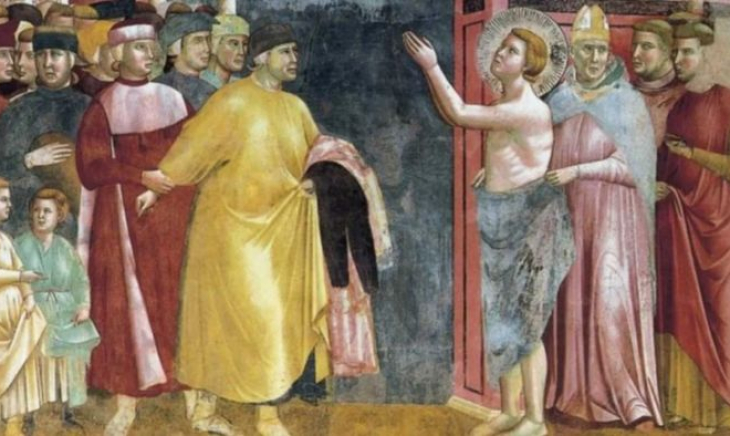
Photo: “St. Francis Renounces Worldly Goods”: Giotto’s fresco (1292–1296) is housed in the Upper Basilica of Assisi